Voice infrastructure · Call labeling & deliverability
Flagged as "Scam Likely"? How to Get Your Business Number Cleared
You dial a customer, everything is legitimate, and their phone lights up with "Scam Likely." So they do not answer. It is one of the most frustrating things that can happen to a business that lives on the phone: your call is real, your intent is honest, and a label you never asked for quietly kills the connection.
This is a plain-English look at why call labels happen, how to reduce the chance of getting flagged in the first place, and what to do if one of your business numbers is already wrongly labeled.
Prevention first
Prevention is easier than cleanup.
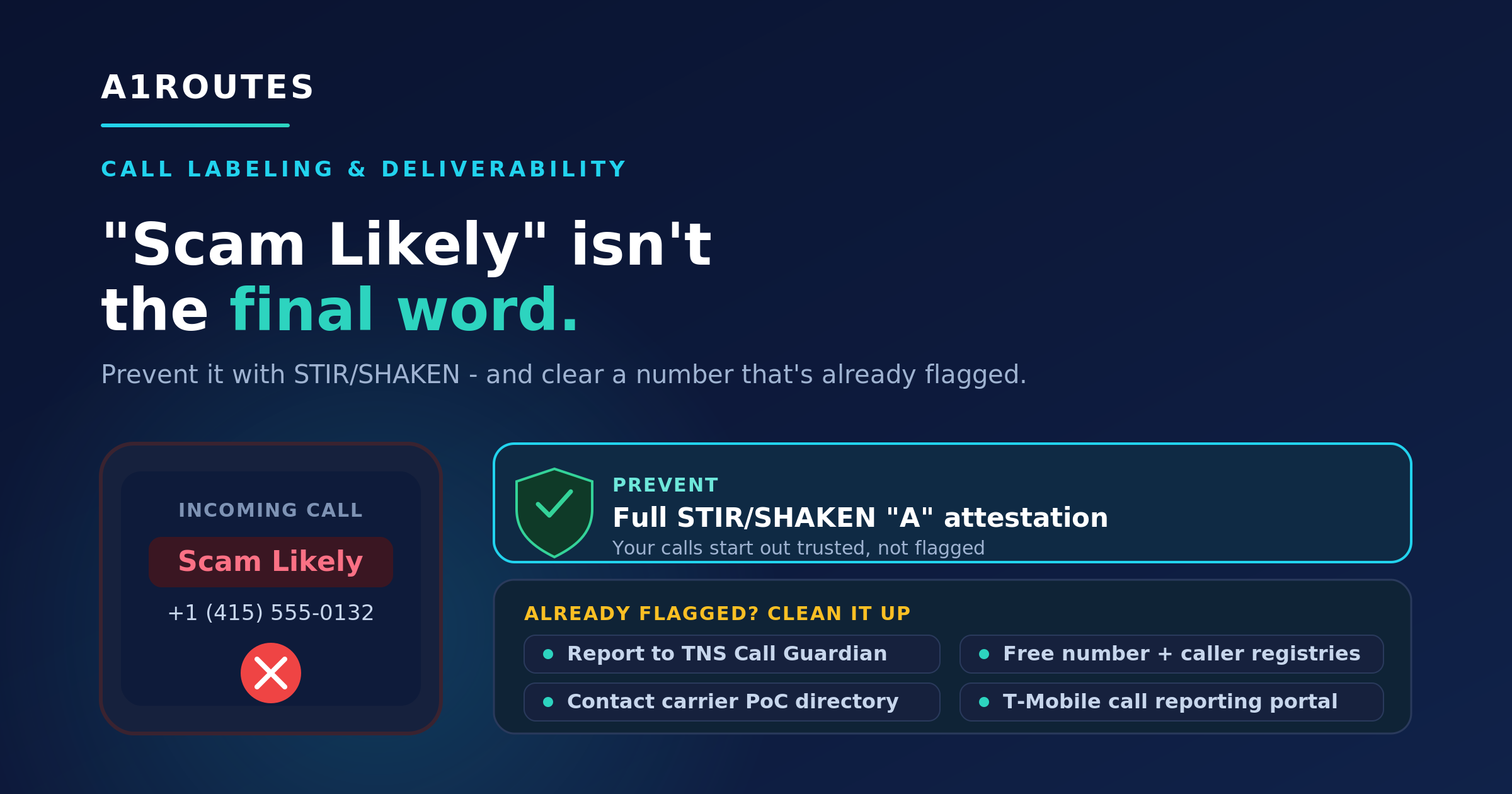
STIR/SHAKEN A attestation, honest caller ID, clean number usage, and proper registration help reduce the chance of legitimate business calls being mislabeled before remediation is needed.
Why legitimate calls get labeled as spam
Blame the robocallers. The sheer volume of scam and nuisance calls in the US pushed the major carriers, and the analytics companies behind them, to label suspicious calls aggressively. You have seen the tags: "Scam Likely," "Fraud Risk," "Spam Risk," and "Potential Spam." In some cases the call is not just labeled, it is blocked outright before it ever rings.
The problem is that these systems work on probability, not certainty. They score calls based on patterns such as call volume, number reputation, authentication, and complaints. Legitimate businesses regularly get caught in the net. A perfectly honest outbound number can end up wearing a scam label it never earned, and every flagged call is a customer who does not pick up.
The best fix is not getting flagged in the first place
Remediation matters, but prevention matters more. This is where call authentication does the heavy lifting. STIR/SHAKEN is the framework carriers use to cryptographically confirm that a call genuinely comes from the number it claims.
The highest level, A attestation, means the carrier is vouching that the caller is known and authorized to use that number. Calls that carry full A-level attestation are less likely to be treated as suspicious because the network can trust where they came from.
This is why A1ROUTES provides full STIR/SHAKEN with A attestation on our numbers, so legitimate business calls can start out with stronger trust signals before labeling becomes a problem. For more background, read Why your business needs A1ROUTES' full STIR/SHAKEN compliance.
One honest caveat: attestation is not a magic shield. Labeling engines from different analytics providers evaluate calls independently, and a number that was ported in already carrying a bad reputation, or one that gets flagged despite good authentication, may still need active cleanup. That is what the rest of this article is for.
If your number is already flagged: how to remediate
If your calls are being wrongly labeled or blocked, which is common with numbers you have ported in from elsewhere, here are concrete steps to get them reviewed. Work through several channels because different carriers and analytics providers pull from different sources.
TNS Call Guardian
Submit a correction request when a number is mislabeled.
Caller registries
Register your business name and outbound numbers.
Carrier reports
Use carrier-specific portals when a network is affected.
Remediation checklist
Where to report or register a wrongly flagged number
Report the mislabel to TNS Call Guardian. TNS is one of the major analytics engines behind carrier labeling. Submit a correction request at reportarobocall.com/trf.
Register your business name and outbound numbers. Use the free number registration service at calltransparency.com. This helps carriers recognize your calls as legitimate and can reduce inadvertent blocking or incorrect spam/scam labels.
Register with the Free Caller Registry. Add the same numbers at freecallerregistry.com/fcr. This shares your business number information with additional call-protection and analytics providers. Registration does not guarantee a label is removed, because each provider evaluates calls independently.
Go straight to the carriers. The industry maintains a directory of call labeling and blocking points of contact. Use it to reach the specific carriers where your calls are being affected.
For T-Mobile specifically: if calls to T-Mobile customers are being incorrectly identified or blocked, submit a report through the T-Mobile Call Reporting portal. This is for calls affected on the T-Mobile network.
Together, these steps can correct a lot of mislabeling and noticeably improve call delivery. Set the right expectation, though: because each analytics provider scores calls on its own, clearing a label with one does not automatically clear it everywhere. Treat remediation as cleanup across providers rather than a single switch you flip.
Number reputation review
Seeing labels on legitimate business calls?
A1ROUTES can review how your numbers are authenticated, presented, routed, and used so your team can reduce labeling risk and work through remediation where needed.
Keep your numbers clean after you have fixed them
Getting un-flagged is only half the job; staying un-flagged is the other half. A few habits protect number reputation over time: present an honest, consistent caller ID instead of rotating through spoofed-looking numbers, avoid blasting enormous call volumes from a single number in short bursts, keep calling within reasonable hours, honor do-not-call preferences, and route calls over authenticated, reputable paths so they keep carrying good attestation.
Reputation is earned call by call. It is much easier to protect than to rebuild.
The short version
Spam and scam labels exist because robocalls made carriers cautious, and legitimate businesses get caught in the crossfire. The strongest defense is starting on numbers with full STIR/SHAKEN A attestation so your calls begin with better trust signals.
If a number is already flagged, especially one you ported in, work through the registries and reporting channels above to clean it up, then keep your calling honest and well-paced so it stays clean.
If your business calls are getting labeled or blocked and you are not sure where to start, get in touch or book a Voice Reliability Review. We will look at how your numbers are authenticated and presented today, and help you both clean up existing flags and reduce the chance of new ones.
The third-party registries and reporting tools linked above are provided by their respective operators; A1ROUTES is not affiliated with them, and their processes and outcomes are outside our control.
Call labeling support
Clean up the label, then protect the number
If your legitimate business calls are showing as "Scam Likely," "Spam Risk," or getting blocked, A1ROUTES can help review your STIR/SHAKEN posture, caller ID presentation, route quality, and remediation options.