Telecom insight / how-to · Education consultancies
The Calling Playbook for Education Consultancies: Why Your Best Leads Never Pick Up
You spend real money acquiring a serious study-abroad enquiry. Education fairs, Meta ads, referral commissions, the counsellor's time. Then the whole thing comes down to one moment: a student, or often their parent, looking at a ringing phone and deciding whether to touch the green button.
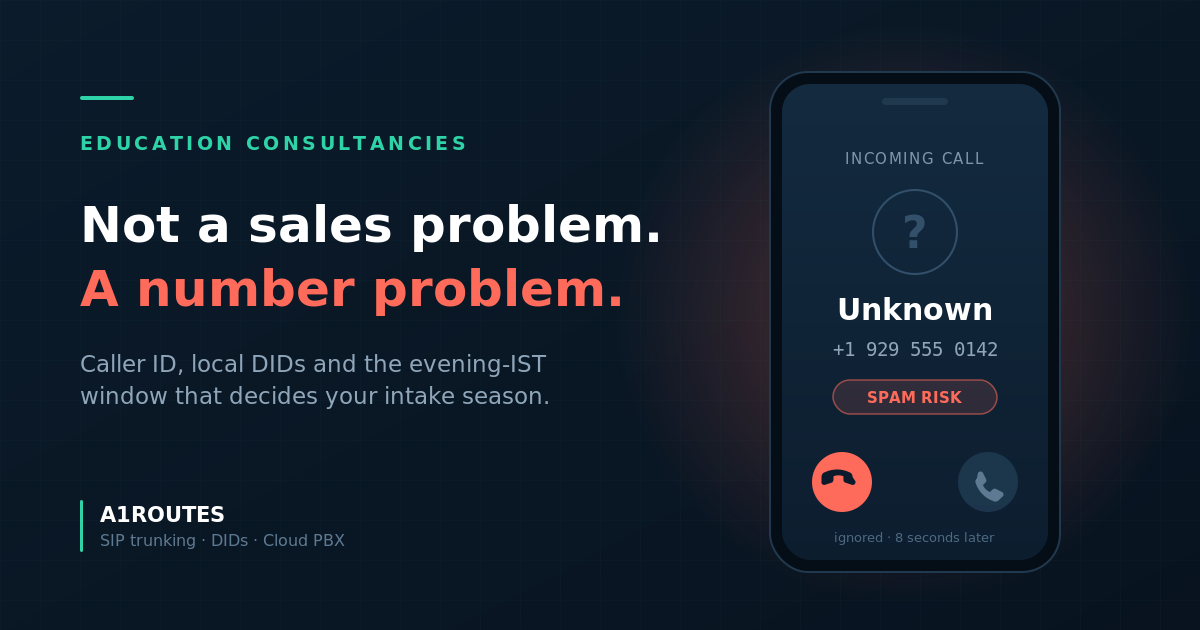
If the screen shows an unfamiliar international number, "Unknown," or a number that feels mismatched to their market, many students do not answer. This is not only a sales problem. Your counsellors may be fine. It can be a number, caller ID, timing, and visibility problem — and a lot of it is fixable at the telecom layer.
Quick answer
Education consultancies lose valuable student leads when calls look unfamiliar.
Education consultancies often lose valuable student leads because calls come from unfamiliar, mismatched, or poorly reputed numbers. A better setup uses local DIDs in source markets, direct numbers for counsellors, honest caller ID, SIP cause-code visibility, time-zone-aware routing, and speed-to-lead workflows so teams can reach students and parents when they are most likely to answer.
Core idea
The phone is where the lead becomes real.
A student enquiry is only valuable if the student or parent answers. The number you call from, when you call, and what your team can learn from failed calls all affect conversion.
Why do study-abroad leads not pick up calls?
Three things stack up in education calling.
Your leads are spam-hardened. An 18-year-old with an IELTS score may already have their number circulating across several lead sources. By the time your counsellor calls, they have been trained to ignore unknown numbers. On some cold study-abroad lists, teams may see answer rates in the 12-20% range when calling from a mismatched number; with a local number the student recognises as local, some teams observe meaningfully stronger answer-rate patterns. Treat those ranges as examples, not universal guarantees.
The decision-maker may not be the lead. The student fills the form. A parent may take the call about tuition, living costs, or a loan. That can be a second number, sometimes answered only in the evening. If your CRM only has one number and one calling window, you may miss the person who actually signs.
You are calling across borders in both directions. Indian students calling a UK office. A Dubai counsellor calling a family in Kerala. An admissions team following up with a student already in Toronto. Each direction has a different answer to "which number should we show?"
What number should education consultancies call from?
There is no single right answer, so here are the practical options.
Option A: one national number for everything. This is simple to run: one number in ads, one number on the website, one caller ID. It can work if your entire market is one region and your brand is already known there. But answer rates can suffer when the same number calls students outside that region, and it gives little campaign attribution.
Option B: local DIDs in each source market. You use local numbers where your students are: for example, a local DID for Telangana leads, a local DID for Kerala, a number for Nepal, Nigeria, or another source market where available. The point is not to spoof identity. The number should belong to your business and be used honestly and compliantly. The student sees something more familiar, and your team gets a clearer path for callbacks.
The caveat matters: local presence only works if you honour it. If a student calls a local number and lands in an overseas IVR at 3 AM local time, you have spent the trust you just bought. Route the DID to a team that can actually answer in that time zone.
Option C: local DIDs per campaign and per counsellor. This is the fuller build. Each ad source gets its own DID so you know which channel produced a booked consultation, and each counsellor gets a direct number they give the family after the first call. There are more moving parts, but serious volume usually ends up here.
For many consultancies, the practical starting point is Option B in the top three source markets, then adding per-campaign DIDs once ad spend is high enough that attribution matters.
Why do education consultancy numbers get flagged?
If your outbound number shows "Scam Likely," "Spam Risk," or quietly gets sent to voicemail, the issue is usually a carrier analytics model, not the student's phone. For US and Canadian traffic, STIR/SHAKEN attestation and number reputation can influence how calls are evaluated. For other markets, local carrier rules, traffic patterns, and caller ID handling also matter.
What helps is boring but effective: use verified, company-owned numbers; avoid hammering one DID with burst dialing; maintain some inbound legitimacy on numbers where appropriate; keep call behaviour honest; and ask your provider what attestation and caller ID treatment your traffic carries. For more detail, see our guide on what to do when a business number is flagged as Scam Likely and the background on STIR/SHAKEN compliance.
No provider can magically guarantee that every number will never be labeled. The practical goal is to reduce risk and build better number reputation from the start.
Are WhatsApp messages enough for student recruitment?
WhatsApp is essential, and it is not enough. It is where the relationship often lives after contact: document collection, offer letters, visa checklists, parent questions, and deadline reminders. But first contact and money conversations still often happen on a phone call, especially when a parent needs confidence before paying application fees or committing to a loan.
The pattern that works: call from a number that fits the market, then follow up through a channel the student recognises. If WhatsApp is part of the workflow, make sure the number strategy, ownership, and registration rules are understood before buying numbers in volume. Not every virtual or VoIP number is accepted for every messaging use case.
Why should counsellors have direct numbers?
Give each counsellor a company-owned DID, presented as their direct line. After the first consultation, the family saves that number as "Priya — your consultancy." Every later call from Priya now looks like a known contact, not another unknown caller.
Behind the scenes, the DID can route to the counsellor's extension, fall back to a team queue if they are on another call, and ring an after-hours destination during peak intake if that is part of the process. The family experiences one relationship. The consultancy keeps routing control.
This should be a company DID, not the counsellor's personal mobile. When a counsellor leaves, the number and relationship history should stay with the consultancy and be reassigned through the proper process.
What time should education consultancies call student leads?
Time zones decide more campaigns than teams admit. Students in India often answer after college and before dinner; parents may answer in the same evening window. If a counselling team is working another time zone, the calls may land too early, too late, or when nobody with buying authority can talk.
There are three operational answers: shift a sub-team's hours, staff closer to the source market, or use follow-the-sun routing so calls land with the team that is awake and briefed. The telecom part is straightforward: time-of-day routing rules on the DID. The business part is harder: having the right person ready to answer.
The other half is speed-to-lead. A form fill answered quickly is more likely to become a serious conversation than a lead called the next morning. In practice, that often means a webhook from your form or CRM to your dialer workflow, not a counsellor manually working an export.
What should education consultancies measure in outbound calling?
"Calls made" is a vanity number. Measure the signals that explain whether your student recruitment process is actually working.
- Answer rate per DID. If one number is at 40% and another is far lower, the weaker number may be mismatched, poorly reputed, overused, or wrong for that market.
- Short-call rate. Sub-10-second calls should be tracked separately because they often mean hang-ups, wrong numbers, or poor call introduction.
- Speed-to-lead. Track the time from form submission to first call attempt and first real conversation.
- Contact-to-consultation booked. This connects telecom operations to revenue.
- Cause-code mix by DID and campaign. This tells you whether failures are data, timing, caller ID, route, or destination issues.
How do SIP cause codes help student recruitment teams?
SIP cause codes are the plainest way to stop guessing why calls failed. A good provider should expose enough call-result visibility for your managers to make better retry and lead-disposition decisions. See the full A1ROUTES SIP Cause Codes Guide for the complete reference.
486 Busy Hereoften means the line is genuinely busy. Retry later.480 Temporarily Unavailableoften means phone off, out of coverage, or temporarily unreachable. Try a different window.603 Declineoften means the recipient rejected the call. A rising pattern can point to caller ID or reputation issues.404 Not Foundor484 Address Incompleteoften points to bad or incomplete lead data.403 Forbiddenor clustered503 Service Unavailablecan point to configuration, routing, provider, or carrier-side problems that need review.
For campaign economics, rate guardrails also matter. If teams are dialing unfamiliar international destinations, max outbound rate settings can help avoid accidental high-cost routes. A1ROUTES customers can review how to set up maximum outbound rate.
Operational checklist
The build education consultancies can copy
- Local DIDs in top source markets
- Separate inbound and outbound number strategy
- Direct DID per counsellor
- Company-owned numbers, not personal mobiles
- Time-zone-aware routing
- Fast speed-to-lead workflow
- SIP cause-code visibility
- Weekly answer-rate and cause-code reporting
A practical build for serious education consultancies
For a consultancy doing 200-1,000 outbound calls a day across two or three source markets, the practical build is simple:
- Start with local DIDs in each source market, with enough numbers that no single DID carries the whole load.
- Separate inbound ad-response numbers from outbound calling numbers so attribution and answer-rate analysis do not get tangled.
- Assign one direct DID per counsellor, routed to extension, team queue, and appropriate fallback.
- Use verified, company-owned caller IDs and compliance-aware routing for US, Canada, and other regulated markets.
- Route evening source-market calls to a staffed team.
- Connect the lead form to the dialer or calling workflow for faster first contact.
- Review answer rate and cause-code mix by DID every week.
None of this needs to be a giant migration. Start with one market, one counsellor group, or one campaign. Prove the call path, then expand.
None of this is legal advice. Calling rules, consent requirements, number usage rules, and messaging rules vary by market and should be reviewed for each country you operate in.
FAQ
Student recruitment calling questions
Why do study-abroad leads not pick up calls?
They often ignore unfamiliar, mismatched, or poorly reputed numbers, especially when they have already received many unsolicited calls from education providers.
What number should education consultancies call from?
Most serious teams should use company-owned local DIDs in top source markets, then add campaign and counsellor direct numbers as calling volume grows.
Are WhatsApp messages enough for student recruitment?
No. WhatsApp is useful for follow-up, documents, and relationship management, but high-value counselling and parent conversations often still need a phone call.
Why should counsellors have direct numbers?
A direct company-owned DID helps the student or parent save the counsellor as a known contact while the consultancy keeps routing and relationship control.
What time should education consultancies call student leads?
Call in the student's or parent's active window, not only the consultancy office's working hours. Time-zone-aware routing helps match source-market leads to staffed teams.
What should education consultancies measure in outbound calling?
Track answer rate per DID, short-call rate, speed-to-lead, contact-to-consultation booked, and SIP cause-code mix by number and campaign.
How do SIP cause codes help student recruitment teams?
They help teams separate bad data, busy users, temporary failures, declines, and routing issues so managers can make better retry and follow-up decisions.
Student lead calling review
Want to review your student lead calling setup?
If your education consultancy depends on outbound calling to reach student leads and parents across markets, A1ROUTES can help review your caller ID strategy, DID setup, counsellor direct numbers, SIP cause-code visibility, and time-zone routing.