Travel Voice Infrastructure · Article 4
What Happens to Your Bookings When Your Carrier Goes Down for 3 Hours?
So far in this travel series we have covered how to measure which ads drive bookings, how a DID pool wins repeat customers, and how to get more calls answered. All of that assumes your phones are up. This article is about the day they are not, and why what happens in the next three hours is decided long before the outage starts.
Run the math on three hours of silence
Picture a normal Saturday in peak season. Your ads are live, traffic is high, and booking calls are coming in at your usual rate. Then your carrier has an issue: a route problem, a configuration change, congestion, or an upstream failure. For three hours your inbound line does not connect properly.
The cost is not three hours of inconvenience. It is three hours of your highest-intent traffic hitting a dead line during a window you already paid to create with ad spend. Customers do not wait. They call the next agency in the search results and book there.
Three hours is not just downtime
Paid demand keeps arriving
Your ads, promotions, and search traffic continue sending high-intent callers.
Calls fail or hit voicemail
Customers do not wait when booking intent is high.
Bookings move elsewhere
The next travel agency in the search results gets the conversation.
Attribution gets distorted
A campaign that was working may look weaker because calls never connected.
The real differentiator: ticket queue vs. human escalation
Here is where most travel businesses discover the difference between a vendor and a partner. When calls stop connecting, what are your options?
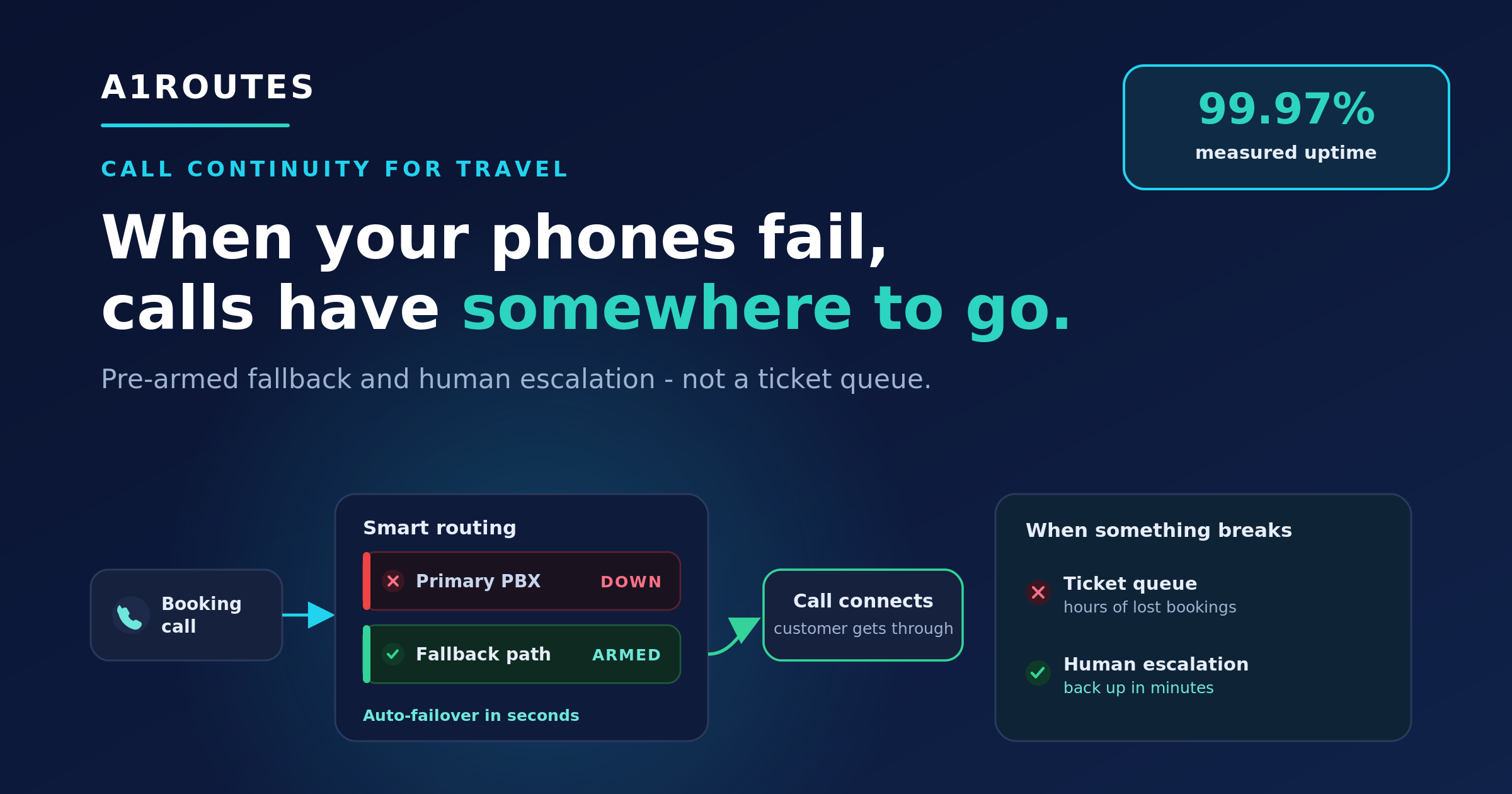
With many large carriers, the answer is a support ticket. You open a case, get a reference number, and wait in a queue while your booking line stays dark. The support process is built for averages, not for the Saturday your revenue is on the line.
The alternative is a setup designed so a human who understands the business impact can be reached quickly, and so calls have somewhere else to go when the primary path fails. That combination, human escalation plus pre-armed fallback, is the continuity plan serious travel teams need.
A ticket number is not a continuity plan
- Submit case
- Wait for assignment
- Generic support flow
- Booking window passes
- Revenue impact discovered later
- Known contact path
- Business impact understood
- Faster diagnosis
- Backup path reviewed
- Calls restored or diverted faster
Fallback routing: somewhere for calls to go
Fallback routing means that if your phones stop answering, calls are automatically redirected down a pre-armed secondary path: a second SIP trunk, a Cloud PBX, a backup office, or a mobile or landline number. The redirect is triggered when your normal answering point becomes unreachable.
The key word is pre-armed. Fallback only protects you if it was configured and tested before the outage. The teams that move through an incident best are the ones who set up and tested the backup path during calm weather, not the ones scrambling while calls are already failing.
How pre-armed fallback routing protects booking calls
Normal answering path.
Human escalation reviews the path.
What fallback can and cannot do
Fallback reliably protects against
- PBX down
- SIP registration lost
- office internet issue
- trunk congestion
- your answering point unreachable
Fallback cannot magically fix
- complete outage of the number-owning provider
- provider-level outage where the rerouting system itself is unavailable
For provider-level resilience, serious operations should consider carrier diversity, backup numbers, or a multi-provider number strategy where appropriate.
Why this matters more for travel than almost anyone
Travel demand is spiky and time-sensitive. It clusters around campaigns, seasons, sales, weekends, and events, exactly when call volume is highest and an outage is most expensive.
A SaaS company that loses its phones for an afternoon can follow up by email. A travel business that loses its phones during a promotion loses bookings that were never going to wait. The cost of downtime is concentrated in your best revenue windows.
Peak campaign readiness
Preparing for a travel campaign spike?
A1ROUTES can review your DID footprint, SIP trunk setup, Cloud PBX fallback, campaign timing, and escalation path before the next high-volume travel window.
Peak season call-readiness checklist
Failure points
- Map your single points of failure
- Do not put all important numbers on one provider
Failover setup
- Set tested failover destination
- Actually trigger failover before campaign
- Keep spare DIDs and a written runbook
Capacity and caller ID
- Check capacity for the spike
- Verify caller ID and answer-rate basics
Escalation and team readiness
- Confirm escalation path is human and fast
- Brief your booking team
How A1ROUTES helps you stay up
A1ROUTES is built around keeping revenue-critical calls connected, honestly, not magically. That means SIP trunking and Cloud PBX with properly configured failover destinations for important numbers, carrier-diverse outbound routing where appropriate, routing visibility, and direct human escalation when something needs fixing fast.
You do not have to move your whole operation to start. Many travel teams begin by arming a tested failover path for one critical campaign, one DID pool, or one region.
Voice Reliability Review
Build your backup path before the outage
A Voice Reliability Review helps identify where travel booking calls can fail: carrier dependency, PBX failure, SIP registration loss, channel capacity, caller ID issues, fallback routing gaps, and slow escalation paths.
A1ROUTES can help you start with one critical campaign, one DID pool, or one region, then expand once the continuity plan is proven.