Travel Voice Infrastructure · Article 3
Why Your Travel Ads Work But Your Phone Doesn't Ring: Caller ID, Spam Flags & Answer Rates
In this travel series we have looked at how dedicated DIDs let you measure which ads drive bookings and how a DID pool wins repeat customers. Both assume one thing: that the call actually connects. This article tackles the problem hiding underneath every travel campaign: your ads are working and generating demand, but a large share of those calls never become conversations.
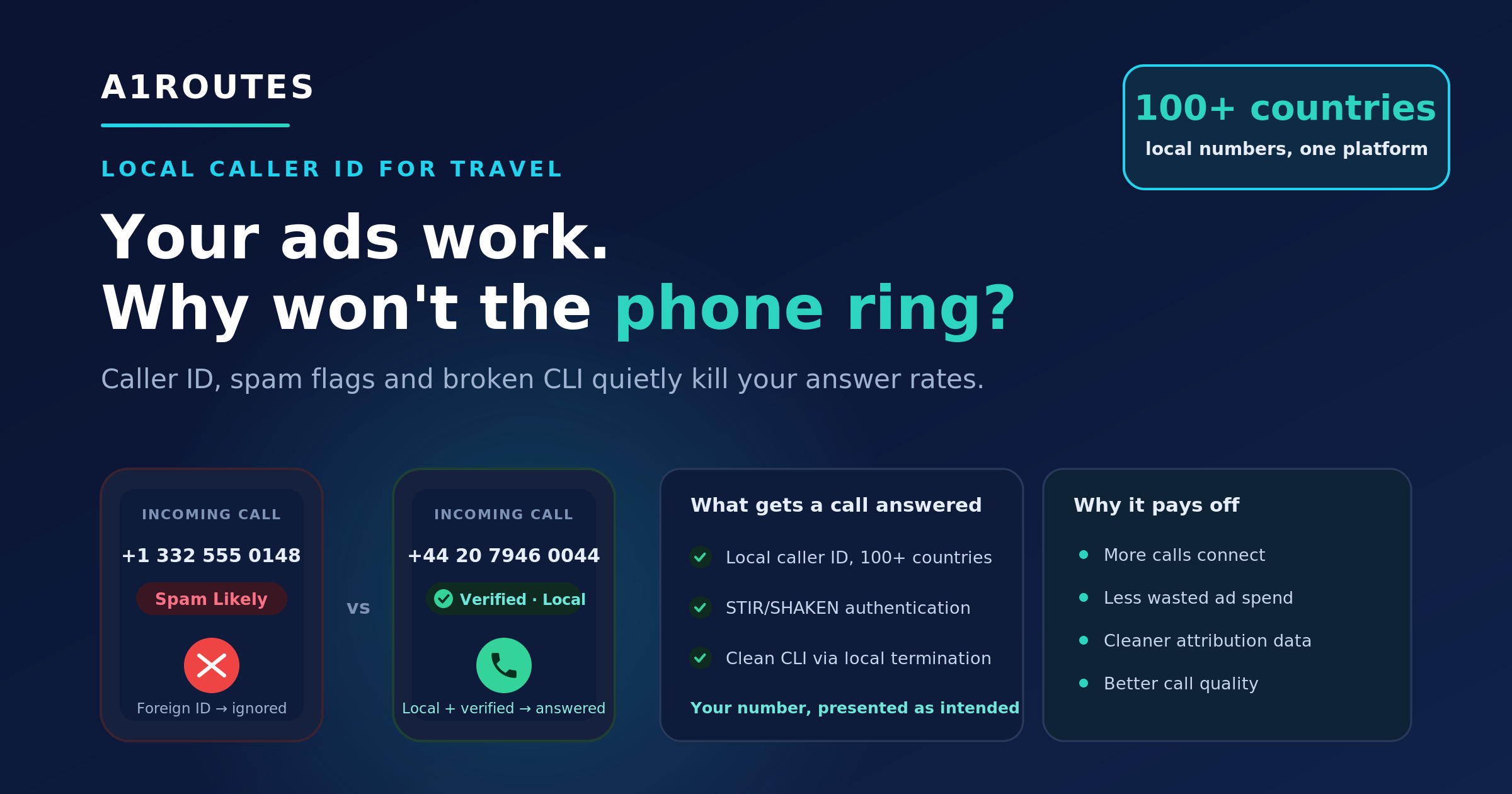
The gap between ad spend and conversation
A travel campaign can be doing its job perfectly: the right audience, strong creative, and a compelling offer. Impressions turn into clicks, clicks turn into calls and callbacks, and then a surprising number of those calls simply go unanswered or never get picked up by the customer.
When that happens, it is tempting to blame the campaign or the agents. But the real failure often sits in the telecom layer: the number on the other end looked unfamiliar, untrustworthy, or suspicious, so the customer never picked up. The ad did its job. The phone let you down.
Why good travel campaigns still lose calls
Foreign-looking caller ID
Customers ignore numbers that do not look familiar or local.
Spam labels
"Spam Likely" or "Scam Likely" can kill the call before your agent speaks.
Broken CLI pass-through
Low-quality routes can strip, alter, or fail to present your caller ID correctly.
Three quiet killers of answer rates
1. Caller ID that looks foreign or unfamiliar. Travel is cross-border by nature. If a customer in London sees an unknown international number, or a customer in Sydney sees a number with no local format, the instinct is to ignore it. People answer numbers that look like they belong to their own country and region.
2. Spam labels and call blocking. Carriers and phones now aggressively label calls as "Spam Likely," "Scam Likely," or "Suspected Fraud." High-volume outbound campaigns, numbers with poor reputation, or calls that fail authentication can get flagged. For a travel business making follow-up and re-engagement calls at scale, spam labeling can quietly reduce connect rates.
3. Broken CLI pass-through. CLI is the caller ID information that travels with your call. As a call crosses networks and borders, low-quality routes can strip, alter, or fail to present your number correctly. Your carefully chosen local number may show up as blank, garbled, or replaced.
The A1ROUTES answer-rate stack
Show up with a number that looks familiar in the customer's market.
Use authenticated, reputation-aware routes to reduce spam-label risk.
Terminate in-country so caller ID passes through cleanly and calls sound better.
The fix part 1: show up local, everywhere your customers are
The single biggest lever on answer rates is presenting a number that looks local and trustworthy to the person receiving the call. A customer is far more likely to answer, and to trust, a number that matches their own country and region.
A1ROUTES provides local numbers across 100+ countries, so whether your travelers are in the UK, the US, Australia, Canada, Singapore, the UAE, Europe, or other global markets, you can plan a caller ID strategy for inbound lines and outbound booking campaigns.
Caller ID planning
Need local caller ID in your top travel markets?
A1ROUTES provides local numbers across 100+ countries and helps travel teams plan caller ID strategy for inbound and outbound booking calls.
The fix part 2: make your calls authenticated, not flagged
Showing up local works best when the call is also trusted by the network. Standards like STIR/SHAKEN help attest that a call genuinely originates from the number it claims, which can reduce spam-label risk for legitimate businesses.
Running your travel calls over properly authenticated, reputation-aware routes helps protect your numbers and supports healthier connect rates over time. STIR/SHAKEN is not a guarantee against spam labels, but it is an important part of a responsible caller ID posture.
The fix part 3: local termination so your caller ID actually arrives
Choosing a local number and authenticating your calls still is not enough if the route mangles your CLI on the way. This is the problem local termination is built to solve.
By terminating calls directly in-country where available, local termination helps your caller ID pass through cleanly and be presented correctly to the customer's handset. It also supports better call quality because the call is not being pushed through a cheap, low-control international path.
What better answer rates are worth
Answer rate is one of the highest-leverage numbers in a travel operation because it sits right at the top of the funnel you have already paid for. If you are spending on ads to generate calls, every unanswered call is wasted spend.
It also compounds with the rest of this series. Local, authenticated, cleanly presented numbers make your attribution data more accurate because more calls connect to be measured, and make your agent direct numbers more useful because repeat customers are more likely to trust the callback.
What travel teams should audit first
A practical way to start
Pick your highest-volume market and look at two numbers: inbound answer rate and outbound connect rate. Then move that market onto a local number with local termination and authenticated routing, and compare.
Most teams see the difference quickly because the fix targets the exact point where calls were being lost: how the number appears, whether the route preserves CLI, and whether the network treats the call as trustworthy.
Voice Reliability Review
Find out where your travel calls are leaking
If your ads are generating demand but booking calls are not turning into conversations, A1ROUTES can review your caller ID, local numbers, STIR/SHAKEN posture, local termination routes, and answer-rate signals.