Travel Voice Infrastructure
How Travel Businesses Use A1ROUTES DIDs to Track Which Ads Drive Booking Calls
Travel is one of the few industries where the most valuable conversions still happen by phone. Someone sees an ad for a holiday package, a cruise, a flight deal or a group tour, and they call to book. That call is where the revenue is - and it is also where most ad tracking goes completely dark. This article explains how A1ROUTES DIDs (direct inward dialing numbers) let travel teams connect inbound booking calls back to the exact ad, platform and campaign that produced them.
The attribution blind spot in travel marketing
If your bookings closed entirely online, attribution would be straightforward. Your ad platforms and analytics would show you which campaign earned the click, the form fill and the sale, and you would simply spend more where the numbers are strong.
But travel rarely works that way. High-ticket and complex trips - multi-city itineraries, family holidays, cruises, group travel, premium fares - involve questions that customers want answered by a person before they commit. So they call. The moment that call leaves the browser and lands on your phone line, the trail that connected it to a specific ad disappears. You can see that ad spend went out and that bookings came in, but the link between the two is broken.
The result is the uncomfortable position most travel marketers know well: you are confident that some of your ad spend is working, but you cannot prove which part. You scale budgets on guesswork, keep underperforming campaigns alive out of caution, and cut others without knowing whether they were quietly driving your best phone bookings.
What a DID actually is - and why it doubles as a tracking number
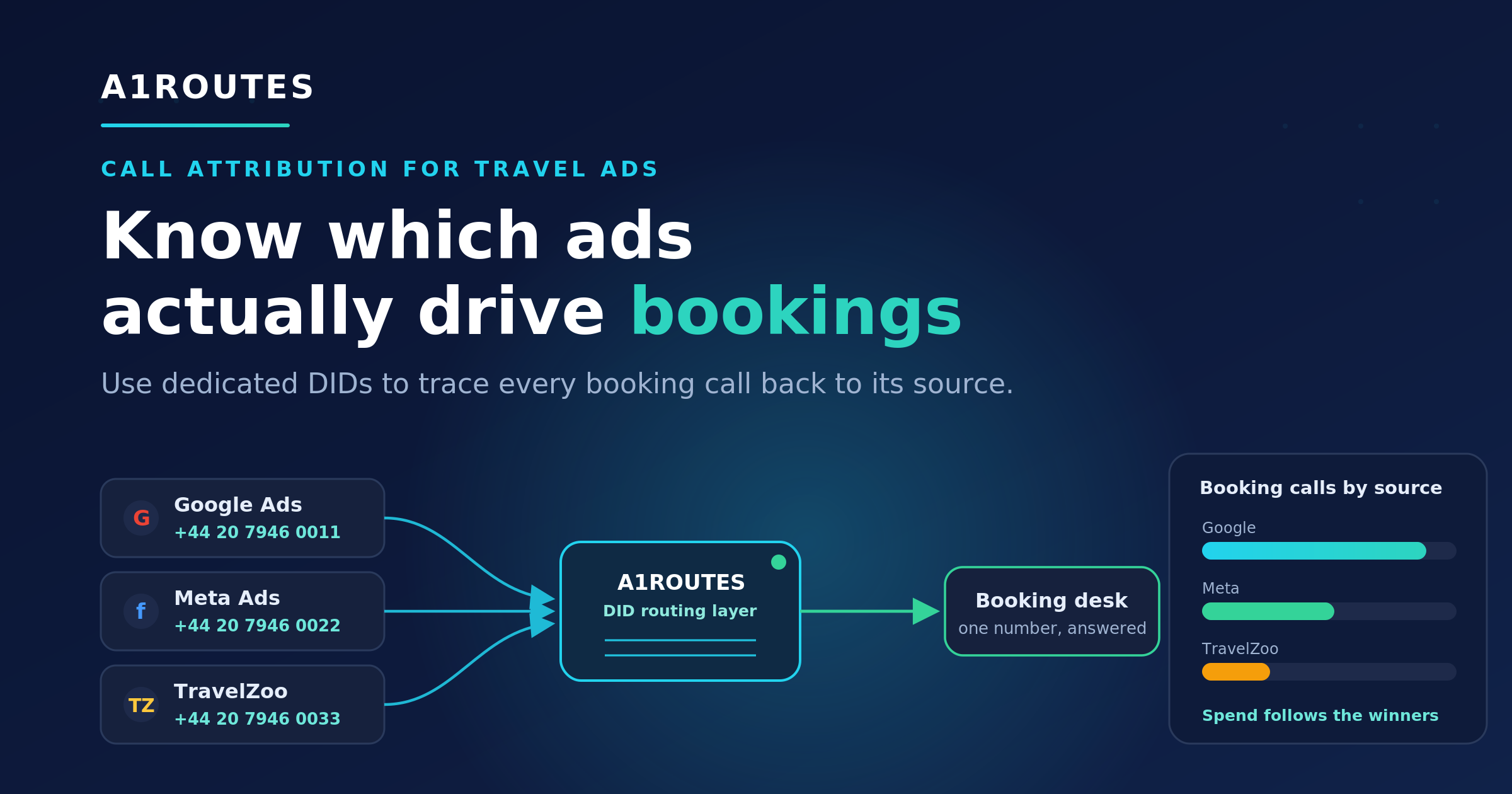
A DID is simply a phone number that routes inbound calls to your team. Because each DID is a distinct, addressable number, it can carry information by virtue of which number was dialed. Assign a unique DID to a single ad, campaign or platform, point all of those numbers at the same booking desk, and the number a customer dials becomes a label that tells you where they came from.
This is the same principle as a UTM parameter on a web link - but for voice. A customer who calls the number shown only on your Google Search ad has effectively identified that channel by dialing it. The customer never notices anything different; they simply call and book. Behind the scenes, you now know that this booking call originated from Google Search rather than Meta, TravelZoo, a print insert or an organic listing.
DIDs alone are not enough
A tracking number only helps if the call actually connects.
For travel teams, attribution and reliability have to work together. If a campaign generates calls but the DID route fails, caller ID looks unfamiliar, or calls hit busy paths during peak demand, the team loses both the booking opportunity and the attribution signal.
A1ROUTES helps travel teams combine DID-based attribution with reliable routing, SIP trunking, Cloud PBX, backup paths, Smart Caller ID strategy, and direct escalation.
Two ways to set it up
Static number assignment. The simpler approach: you allocate one dedicated DID per channel or campaign. A UK number for your UK Google campaign, a different number for Meta, another for your TravelZoo placement, another for email or retargeting. This is reliable, easy to reason about, and ideal for a focused set of campaigns or markets. It works across both digital and offline placements, which matters in travel where brochures, partner sites and referral channels still drive calls.
Dynamic number insertion (DNI). For higher-volume, web-driven campaigns, a small pool of DIDs is rotated on your landing pages so that individual visitors - and even specific keywords or sessions - can be matched to the calls they place. DNI gives finer-grained attribution down to the campaign, ad group or keyword level, at the cost of a slightly more involved setup. Many travel teams begin with static numbers per platform and graduate to DNI once they want keyword-level detail.
In both models the foundation is the same: a pool of DIDs across the markets your customers call from, all routed cleanly into your existing booking desk through a SIP trunk or Cloud PBX, with the source of each call captured against it.
What you can finally measure
Once calls are tagged by source, the questions that were unanswerable become routine reporting:
- Cost per booking call by platform. Not cost per click or cost per impression - cost per call from a real person with booking intent, broken out by Google, Meta, TravelZoo and every other source.
- Which campaigns drive calls versus just clicks. An ad with a mediocre click-through rate may quietly generate your highest-value phone bookings. Without call data, you would have paused it.
- Performance by market and region. See whether your UK, US, EU or AU numbers are pulling their weight, and reallocate toward the geographies that convert.
- Time-of-day and day-of-week patterns. Discover when booking calls actually arrive so you can staff the desk and schedule ad delivery around real demand rather than assumptions.
- True channel ROI. Combine call volume and booking outcomes with spend to rank channels by revenue produced, not by surface-level engagement metrics.
Turning the data into spending decisions
Attribution is only useful if it changes what you do next. With per-source call data in hand, three decisions get much easier. You can cut the campaigns that generate clicks and form fills but few booking calls, recovering budget that was leaking. You can scale the platforms with the lowest cost per booking call with the confidence that you are feeding winners. And you can reallocate across regions and dayparts to match where and when real demand shows up.
For a lean travel team spending real money on paid acquisition, even a modest reallocation - moving budget from a channel that looked good on clicks to one that actually rings the phone - can meaningfully change cost per booking without spending a rupee more.
The piece most call-tracking tools miss: the call has to connect
Here is the catch that pure software tracking tools rarely address. Attribution data is only as honest as your call delivery. If a customer calls the number on your best-performing ad and the line is busy, the call quality is poor, or the call simply fails to connect during a campaign traffic spike, two things happen at once: you lose the booking, and you lose the attribution signal that would have told you the ad was working. A missed call does not just cost revenue - it corrupts your data and can lead you to wrongly conclude that a good campaign is underperforming.
This is why call tracking and call reliability belong together. Tracking numbers tell you which ad drove the call; reliable routing makes sure that call is answered so the data reflects reality. The two only work as a pair.
How A1ROUTES fits in
A1ROUTES provides the voice infrastructure layer that makes call-based ad attribution practical for travel teams. That means global DIDs across the UK, US, EU, Australia and other markets your customers call from, all delivered into your existing setup through SIP trunking or Cloud PBX. You can stand up a dedicated DID pool for your campaigns, route every number to the same booking desk, and keep clean records of which number each call arrived on - the raw material for attribution.
Just as importantly, A1ROUTES is built around keeping those revenue-critical calls connected: smart caller ID strategy, routing visibility, backup routing for campaign spikes, and direct human escalation when something goes wrong - so a surge of booking calls from a winning ad does not turn into busy tones and lost data. You do not have to migrate everything at once; many teams start by routing a single campaign or region through a tracking DID pool, prove the model, and expand from there.
Getting started
A practical first step is to pick your two or three biggest ad channels, assign a dedicated DID to each, route them all into your current booking desk, and start logging calls by source for a few weeks. That alone usually surfaces at least one surprise about where your real booking calls are coming from. From there you can layer in more numbers, more markets, or dynamic number insertion for keyword-level detail.
If you want help designing the number pool and routing so your attribution data stays clean under campaign load, book a Voice Reliability Review and we will map it to your current campaigns, markets and call volume - or talk to us about setting up a tracking DID pool for your next campaign.
How A1ROUTES makes DID attribution practical
A1ROUTES can help design the DID pool around your campaigns, markets, and booking desk workflow. For example:
- one DID per ad platform
- one DID per region
- one DID per campaign
- one DID pool for seasonal promotions
- routing into your existing SIP trunk or Cloud PBX
- backup routing during campaign spikes
- call records showing which DID received each call
This gives travel teams a practical way to test attribution without replacing their full calling setup on day one. See how reliability matters in our travel call reliability case study.
Voice Reliability Review
Want to test DID-based attribution without buying numbers one by one?
Qualified travel agencies can start with up to 50 cost-free DIDs across USA, UK, Australia, and Singapore markets with a $250 monthly committed spend.
A1ROUTES can help map those numbers to your campaigns, regions, platforms, and booking desk workflow - then route calls through SIP trunking or Cloud PBX with backup routing and direct escalation.
Subject to qualification, KYC approval, market availability, fair-use review, and A1ROUTES approval.