Travel Voice Infrastructure · Article 5
You've Already Paid for the Call. Here's How to Turn More of Them Into Bookings.
So far this series has been about getting the call to happen and getting it answered: measuring which ads drive it, keeping repeat customers coming back to their agent, lifting answer rates, and staying up when a carrier wobbles. This one is about what happens next: once the call is coming in, how do you turn more of those conversations into actual bookings?
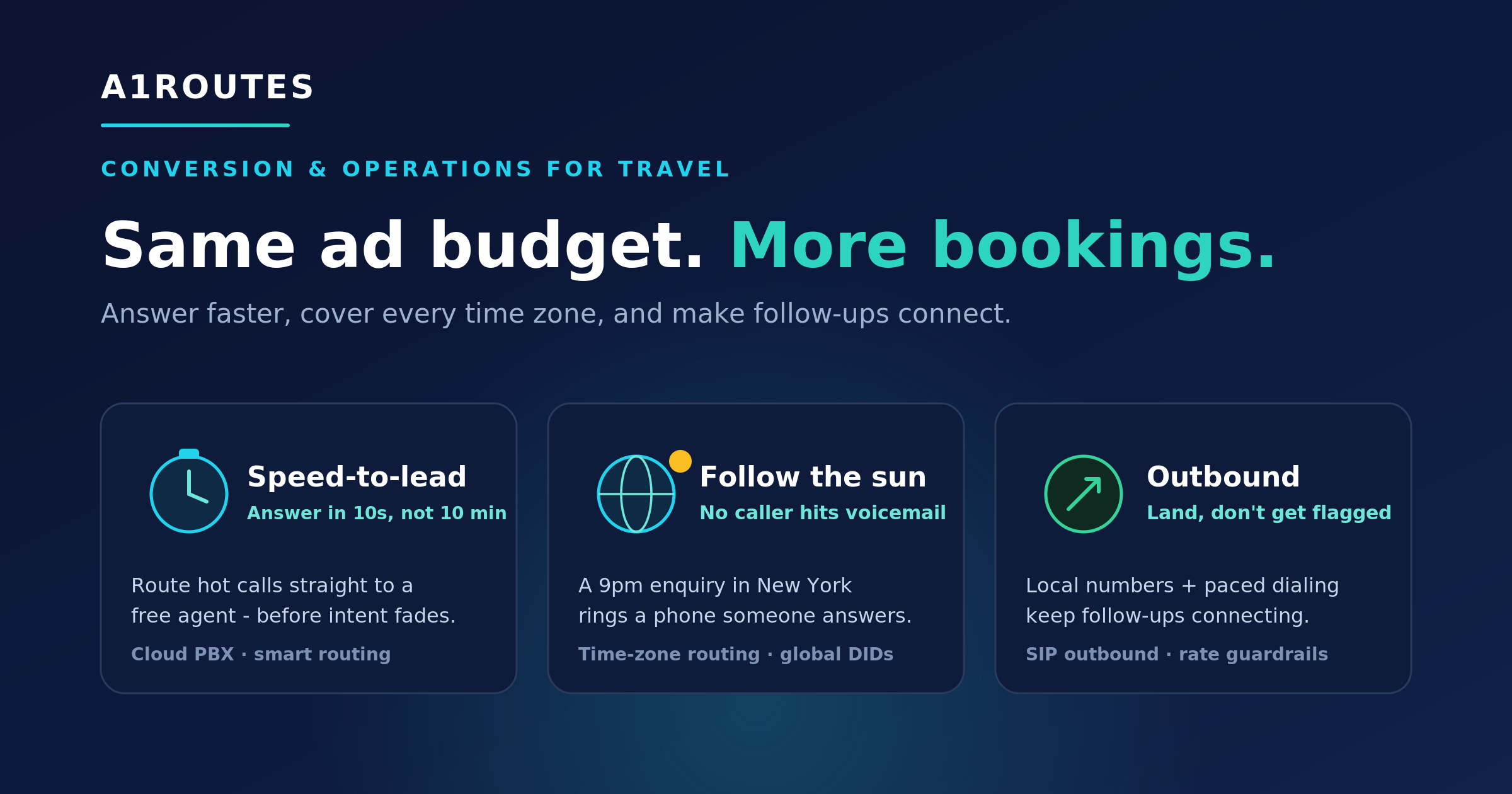
Same ad budget. More booking conversations.
Speed-to-lead
Route hot inbound calls to available agents before intent fades.
Follow-the-sun routing
Send after-hours calls to a team that is awake and ready to answer.
Outbound that connects
Use local numbers, caller ID strategy, and pacing so follow-ups land.
Where travel calls leak after the ad works
1. Speed-to-lead: the first ten seconds decide a lot
A traveler calling right now, with their card half out of their wallet, is worth far more than the same person twenty minutes later. Intent is fragile. If they do not get a person on the line, they tap the next result.
That is why answering in ten seconds beats calling back in ten minutes. By the time you call back, the mood has passed, they are in a meeting, or they have already booked elsewhere. The call you paid an ad to generate becomes a game of phone tag.
The problem is usually not that agents are lazy. It is that the call does not reach the right person quickly enough. It rings a general line, sits in a menu, or lands with someone who has to transfer it. Every one of those seconds is intent leaking away.
This is where sensible routing and a proper Cloud PBX earn their keep. Get the call to a real, available agent on the first ring, ideally one who fits the enquiry, and you can convert more of the same traffic without spending more on ads.
Speed-to-lead review
Are hot booking calls reaching the right agent fast enough?
A1ROUTES can review your inbound call flow, hunt groups, Cloud PBX setup, routing rules, and agent availability to identify where high-intent calls are slowing down.
2. Follow the sun: stop sending high-intent callers to voicemail
If you sell travel across borders, your callers do not keep your office hours. A customer in New York may get excited about a trip at 9pm their time, which could be the middle of your night. If that call hits voicemail, it is often a lost booking.
Follow-the-sun routing means that whenever a high-intent caller picks up the phone, someone can answer, even if it is not the office they would normally reach. That might mean routing after-hours calls from one market to a team that is awake, softphone users at home, or a shared overflow desk.
For a cross-border operation this is mostly a routing question. With local numbers feeding into a routing layer you control, you can send calls by time of day, market, DID, or team availability.
Time-zone routing
Your customers do not follow your office hours
If you sell travel across countries, enquiries can arrive while your main office is closed. A1ROUTES can help route calls by time zone, market, DID, or team availability so more high-intent calls reach a live person.
Plan Follow-the-Sun Routing3. Outbound that lands: your follow-ups are only worth something if they connect
Not every booking closes on the inbound call. Travel runs on follow-ups: the quote you promised to chase, the customer who went quiet, or the past traveler who may be ready for their next trip. A follow-up call that does not get answered is worth very little, no matter how good your list or timing is.
Outbound is where connect rates quietly fall apart. Dial from a number that looks foreign or unfamiliar and customers may not pick up. Push too much volume through one number and it can start getting tagged as spam, even for warm leads.
Dial from local numbers that match the customer's market where available, then pace outbound sensibly. Blasting too much volume from one number in a short burst can damage number reputation. Sensible max outbound rate guardrails and route controls help protect your DID pool and keep follow-ups looking like normal, answerable calls.
A properly set up SIP trunk for outbound, with local presentation and rate guardrails, helps keep re-engagement calling working month after month instead of degrading into ignored calls.
Outbound discipline
Fast dialing is not always better dialing
Outbound follow-up only works if customers answer. Local caller ID, pacing, SIP outbound routing, and max outbound rate guardrails help protect number reputation and keep follow-up calls connecting.
Review My Outbound SetupIt all comes back to the same idea
None of these three fixes is about buying more traffic. Speed-to-lead, follow-the-sun routing, and outbound that connects are about squeezing more bookings out of the demand you are already paying to create.
You answer the hot call before intent fades, make sure someone is awake when a caller across the world is ready, and keep follow-up calls landing instead of getting flagged. Same ad budget, more bookings.
Three levers to audit before buying more ads
Speed-to-lead
- How many seconds before a hot call reaches an agent?
- Does the call hit an IVR, queue, or transfer first?
- Can a free agent answer immediately?
Time-zone coverage
- Which markets generate enquiries outside office hours?
- Do those calls hit voicemail?
- Can a team, softphone user, or overflow desk answer?
Outbound follow-up
- Do callbacks use local caller ID where available?
- Are DIDs protected from excessive burst dialing?
- Are follow-up calls being flagged or ignored?
- Do you use SIP outbound routing and rate guardrails?
Where to start
Pick the leak that is costing you most right now. If hot inbound calls are bouncing around before anyone picks up, fix routing and answer speed first. If you serve markets in very different time zones, sort out after-hours routing. If follow-up connect rates are sliding, look at outbound numbers and pacing.
You do not have to fix all three at once. Many travel teams start with one market, one DID pool, one booking team, or one follow-up campaign, then expand once the improvement is proven.
Voice Reliability Review
Turn more travel calls into bookings without buying more traffic
If your travel campaigns already generate calls, A1ROUTES can help review what happens next: speed-to-lead, time-zone routing, Cloud PBX call flow, SIP outbound, caller ID strategy, pacing, and follow-up connect rates.
We can start with one market, one DID pool, one booking team, or one follow-up campaign, then expand once the improvements are proven.