Voice infrastructure · Travel calling series · Article 7
Build It Once: The Travel Call Setup You Won't Have to Rebuild in a Year
This series has walked through the pieces of a travel calling operation - attribution, repeat bookings, answer rates, continuity, conversion, and the numbers that matter. This one is for anyone standing at the start line - launching a new travel operation, or scaling one that's outgrowing its setup.
Architecture note
Start small, but start on the right stack.
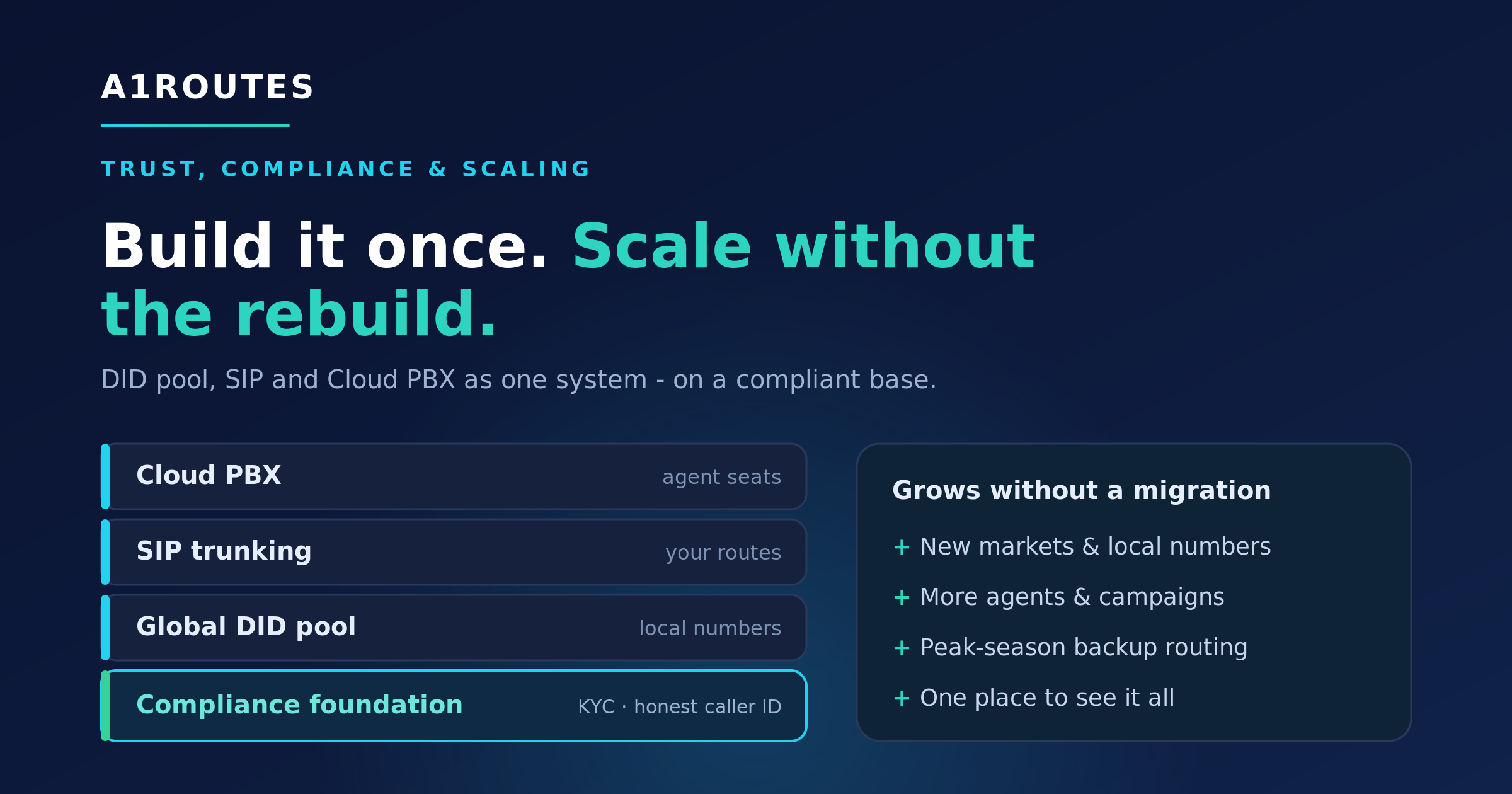
A travel team can pilot one campaign or market without rebuilding later if the DID pool, SIP trunking, Cloud PBX, KYC, and caller ID strategy are designed as one system from day one.
The setup most teams regret
Almost every travel business starts the same way. You grab a cheap number from one provider, a softphone from somewhere else, maybe a second number when you enter a new market, and you glue it all together with good intentions. It works - for a while.
Then the bookings pick up, you add agents, you open a second and third market, and suddenly you're running five disconnected tools that don't talk to each other, numbers scattered across providers you can barely keep track of, and no clean way to see or route anything.
That's the moment teams discover the real cost of a piecemeal setup: to grow, you have to rip it out and rebuild - usually right when you're busiest and can least afford the disruption. The cheap start turns out to be the expensive one.
One system, not five bolt-ons
The setups that scale cleanly treat calling as one system rather than a pile of separate purchases. In practice that means three things working together instead of fighting each other:
A DID pool gives you numbers on tap - local presence in each market you serve, ready to assign to campaigns, agents, or new desks without hunting down a new provider every time. SIP trunking carries your inbound and outbound calls on routes you control and can grow, connecting to whatever answering setup you run. And Cloud PBX gives agents a place to actually take calls - no on-premise hardware to outgrow, add a seat when you hire, remove one when you don't.
When these three come from one coherent stack, growth stops being a project. Opening a new market is adding numbers to a pool you already have. Hiring five agents is adding five seats. Launching a campaign is pointing a few tracking numbers at a desk. You're extending something, not rebuilding it - and you get one place to see and route calls instead of five dashboards that disagree.
DID pool
Numbers for campaigns, regions, desks, and agent callbacks.
SIP trunking
Inbound and outbound routes that connect to your answering setup.
Cloud PBX
Agent seats, call handling, and routing that can grow with the team.
What "scales without a rebuild" actually looks like
Concretely, a setup you won't outgrow lets you do all of this without changing platforms: add local numbers in new countries as you expand, spin up dedicated tracking DIDs for each campaign, give new agents their own direct lines, route calls across markets and time zones, arm backup paths for peak season, and turn outbound up or down - all on the same foundation.
Nothing above needs a migration. That's the whole point. You decided the architecture once, and everything after is just turning dials.
This is also why we usually tell new operators to start small but start right: pilot one campaign or region, but build it on a stack that's ready to carry the whole operation later. Starting right is not the same as starting big.
Compliance isn't the enemy of conversions - sloppiness is
Here's where a lot of ambitious travel operations trip. In the rush to dial more and book more, they cut corners on compliance and number hygiene - and it quietly wrecks the very conversions they were chasing. Getting flagged, blocked, or shut down doesn't just create legal risk; it destroys your reachability, which is the thing your whole operation depends on.
Done right, compliance and conversions pull in the same direction. A few basics that matter, especially when you're calling internationally:
KYC is a feature, not a hurdle. Serious providers ask you to verify who you are and what you're calling for. It feels like friction when you're in a hurry, but it's exactly what keeps the ecosystem clean - and it protects legitimate operators like you from being lumped in with the spoofers and scammers who get numbers blacklisted. If a provider doesn't care who you are, that's not convenience, it's a warning sign about the company you'll be keeping on their routes. Ours is straightforward - see our KYC process.
Caller ID strategy: present honestly, present locally. Show up as a real, local number that belongs to you in the market you're calling - not a spoofed or misleading one. Honest local presentation is both the compliant path and the one that gets answered, which is a rare case where doing the right thing and the profitable thing are identical. We went deep on this in the answer-rates article.
Know the rules of the markets you call into. Different countries have different expectations around consent, calling hours, and how you can contact people - especially for outbound. You don't need to become a telecom lawyer, but you do need to respect local calling windows, honour do-not-call preferences, and keep your outbound paced and reputable so you're not behaving like a spam operation even by accident. This protects your number reputation as much as it protects you legally.
None of this is legal advice - regulations vary by country and change over time, so check the specific rules for the markets you operate in.
Travel calling architecture
Planning a travel call setup you can grow into?
A1ROUTES can review your DID pool, SIP trunking, Cloud PBX, KYC, caller ID strategy, and fallback routing plan before you scale into more markets or agents.
The trust dividend
All of this compounds into something worth having. Numbers that are verified, presented honestly, and dialled at sensible volumes build a good reputation - and a good reputation means your calls keep getting delivered and answered instead of flagged and blocked.
Compliance and clean setup aren't a tax on growth; they're what keeps growth from quietly strangling itself. The operators who last are the ones whose numbers people still trust a year in.
Where to start
If you're launching, resist the urge to duct-tape the cheapest pieces together. Decide the architecture once - DID pool, SIP, Cloud PBX on one stack, with KYC and honest caller ID from day one - then start with a single campaign or market on top of it.
If you're already scaling and feeling the seams, the fix usually isn't more tools; it's consolidating onto one system before the next growth spurt forces a messy rebuild.
Either way, if you'd like a second pair of eyes on how to set this up so it grows with you, book a Voice Reliability Review or get in touch. We help travel teams design a calling setup that starts small, stays compliant, and scales without being rebuilt.
Voice Reliability Review
Build the travel call stack once
If you are launching or scaling a travel calling operation, A1ROUTES can help you map DID pools, SIP trunking, Cloud PBX, compliance checks, caller ID strategy, and fallback routing as one system.
Start with one campaign, one market, or one agent group, then expand without rebuilding the call path from scratch.