Voice infrastructure · Travel calling series · Flagship playbook
The Communication Blueprint for Phone-Led Travel Booking Firms
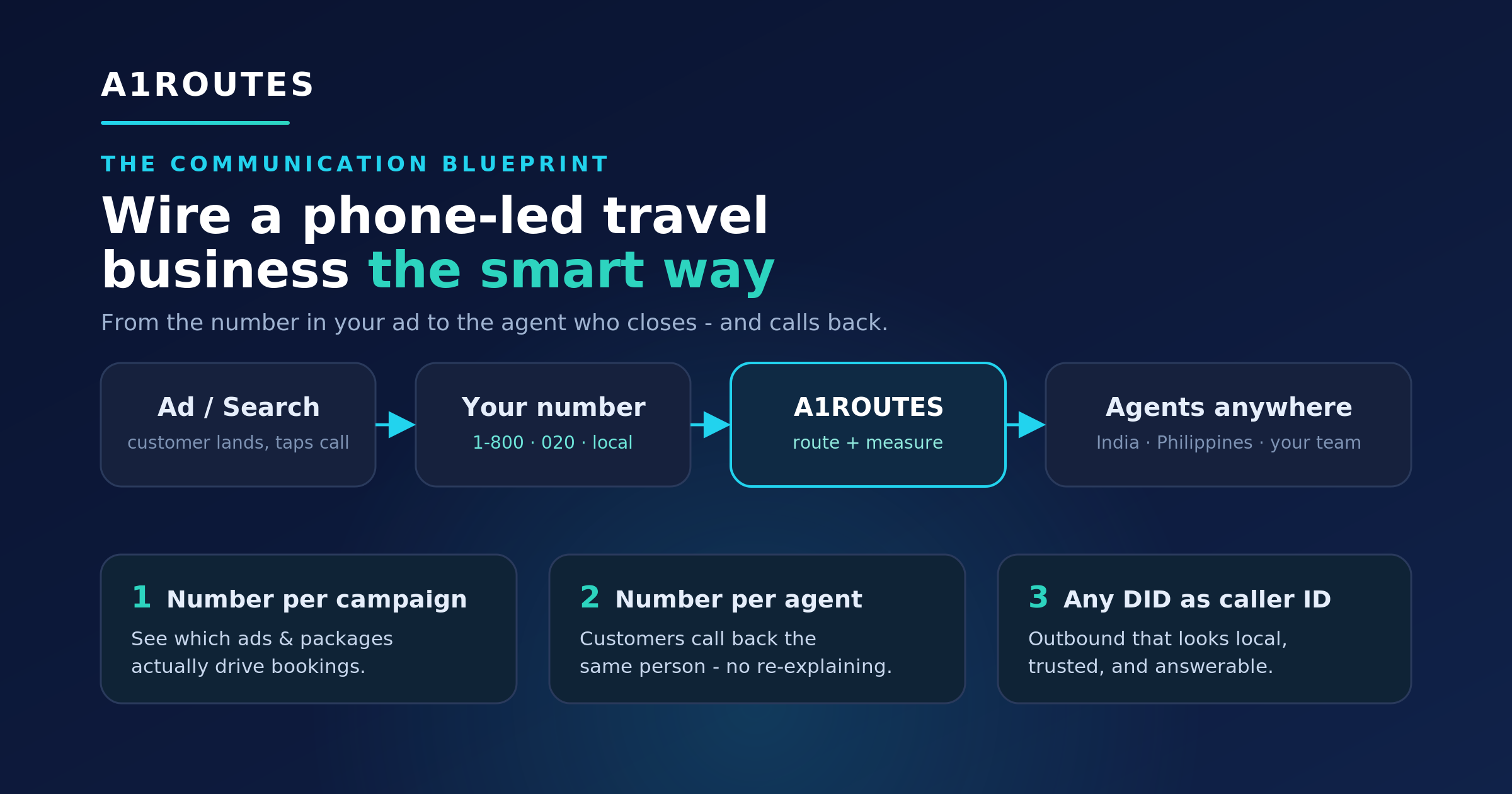
This is the guide we wish someone had handed us: the complete, no-gatekeeping playbook for how a phone-led travel booking business should wire up its calling - from the number a customer taps in your ad, all the way to the agent who closes the booking and calls them back a week later.
We are giving it away because, honestly, the firms that set this up well tend to become the kind of customers we love working with. So here is the whole thing. Steal it, build it, and book more with less.
Operating premise
The phone is the checkout.
For phone-led travel firms, ads and search traffic only matter if the customer reaches the right number, talks to the right agent, and can call back without friction.
Step 1 - The front door: the number customers actually call
Someone finds you through an ad or a search result, lands on your site, and the whole page is really pointing at one thing: call us. That number is your front door, and it should look right to the person dialing it.
In the US, that usually means a 1-800 or 18xx toll-free number because it signals a real, established business and reassures the caller they will not be charged. In the UK, it is typically a London 020 number, because a local presence feels trustworthy and familiar to a British customer.
The pattern holds everywhere: people answer and trust numbers that look like they belong to their own country and city. If you serve multiple markets, you want the right kind of number in each one. With local numbers available across 100+ countries, you can present a familiar face wherever your customers are calling from.
This is not cosmetic. The right front-door number lifts the number of people who dial in the first place and, paired with clean call delivery, the number who actually get through. We went deep on why calls get ignored or flagged in our piece on caller ID and answer rates.
Step 2 - Put your team wherever it makes sense
Here is the quiet superpower of running on VoIP: the number your customer dials and the place your agents sit have nothing to do with each other. A caller rings a London 020 number or a US toll-free line, and that call can be delivered to a booking team in India, the Philippines, or anywhere else you can hire great people at a sensible cost.
That means you can present a premium, local front door to your market while keeping your operating costs lean, which for a travel business fighting on margins is a genuine edge.
Your agents do not need special hardware either. A Cloud PBX and a softphone turn any laptop or desk into a fully fledged booking station. Hire an agent, add a seat. It really is that simple, and it is how lean travel teams punch well above their weight.
Step 3 - Measure everything with a number for every campaign and package
Now for the move that separates the pros from everyone else. You cannot improve what you do not measure, and most travel firms have no idea which ad or which tour package actually generates their booking calls. They see total spend, they see some bookings, and the connection between the two is a black box.
Here is how you open the box: assign a separate incoming number to each ad campaign, or even each tour package. The number a customer dials tells you exactly where they came from. Calls on the number you only put on your Meta campaign? That is Meta working. Calls on the number tied to your Bali honeymoon package? Now you know that package's ads are pulling their weight.
Suddenly you can see cost-per-booking-call by campaign and by product, cut what does not convert, and pour budget into what does. We wrote a whole guide on this: using DIDs to track which ads drive bookings.
Here is where a lot of travel firms get stuck: with most VoIP operators, every extra number costs you. Spinning up a dozen tracking numbers for campaigns and packages turns into a real bill, and you end up rationing the very thing that gives you insight. We flipped that. With our cost-free phone number pool, standing up a number per campaign and per package is simple. Qualified travel businesses get 50 cost-free DIDs for every $250 of committed spend, across the US, UK, Australia, Canada, Singapore and Mexico. Measurement stops being a cost you ration and becomes something you just do. Offer is for evaluated, qualified travel clients.
Step 4 - Give every agent their own number
Travel calls are not quick. A good agent spends real time with a customer: dates, budgets, who is traveling, what went wrong last holiday, and what they are dreaming about this time. Very often the call does not close in one go. The customer wants to think, check with their partner, and call back when they are free.
So give each agent in your center their own fixed line, a regular landline-style direct number they can hand out: "Here is my direct number, call me back anytime." When that customer calls back, they land straight on the same agent who already knows their whole trip. No main-line menu, no queue, no re-explaining the entire plan to a stranger.
That single detail does an enormous amount of work: it makes the customer's life easier, it builds real confidence, and it turns a one-off enquiry into a relationship. In a business built on trust, "just call me directly" is a quietly powerful thing to be able to say. More on this in our piece on agent direct numbers and repeat bookings.
Step 5 - Outbound that carries the right identity
The relationship runs both ways. When an agent needs to call a customer back to chase a quote, confirm a detail, or follow up on that honeymoon package, the call should come from that agent's own number, the one the customer already saved. That way the customer sees a familiar caller ID, recognizes who is calling, and picks up.
This is where our SIP trunk does something most setups cannot: it lets you choose any number from your DID pool as the caller ID on outbound calls. An agent's outbound calls present their assigned direct line; your campaign follow-ups can present the campaign number; your UK team can present a UK number and your US team a US one. You control what shows up on the customer's screen, using numbers you own, so every outbound call looks intentional and trustworthy instead of like a random unknown caller.
Two things keep this working long-term. First, authentication: our numbers carry full STIR/SHAKEN attestation, so your outbound calls start out trusted rather than getting slapped with a "Spam Likely" label. Second, sensible pacing: built-in max outbound rate guardrails stop you from burning a number's reputation by blasting too many calls too fast. Present locally, authenticate properly, pace sensibly, and your follow-up calls keep landing month after month.
Travel call setup
Want the blueprint mapped to your team?
A1ROUTES can review your markets, front-door numbers, campaign tracking DIDs, agent direct lines, SIP outbound caller ID, and backup routing plan.
Step 6 - Make it reliable, and let it follow the sun
Two more pieces turn a good setup into a dependable one.
Reliability. When a booking call does not connect - your PBX drops, your internet blips, your trunk gets congested during a campaign spike - you want the call to fail over automatically to a pre-armed backup path such as a second route, Cloud PBX, or mobile. You also want a real human to escalate to when something is wrong, not a ticket queue. We are honest about what fallback can and cannot do in our continuity article.
Follow the sun. Your customers do not keep your office hours. A 9pm enquiry in New York should not hit voicemail just because it is the middle of the night for your team. Route calls by time of day and by which team is online, so whenever a high-intent caller picks up the phone, someone answers. For a cross-border operation, that is mostly a routing decision, and it is very solvable.
The blueprint at a glance
Put the pieces together and here is the whole machine: a trustworthy front-door number in each market you serve, calls delivered to a lean team wherever your best talent sits, a separate number on every campaign and package so you can see what is working, a direct line for every agent so customers come back to the person they trust, outbound calls that carry the right local, authenticated caller ID, and a reliable, always-answered setup underneath it all.
Market front doors
Market-specific front-door numbers customers trust.
Campaign attribution
Numbers per campaign, package, and source.
Agent callback lines
Direct callback numbers for repeat conversations.
SIP or Cloud PBX
SIP trunking or Cloud PBX for agents anywhere.
Clean caller ID
Any owned DID as outbound caller ID, with KYC and reputation discipline.
Backup routing
Fallback routing, SIP visibility, and call attribution for peak season.
Why we can make this cheap when others cannot
Most of this blueprint is technically possible on other VoIP platforms. It is just painfully expensive or fiddly, especially the "a number for everything" parts that make measurement and agent relationships work. Per-number fees add up fast, and setups get treated as one-size-fits-all.
We built A1ROUTES specifically for revenue-critical calling teams like travel firms: a cost-free DID pool so numbers are something you use freely rather than ration, a SIP trunk flexible enough to present any of your numbers on outbound, Cloud PBX for teams with no hardware, local numbers across 100+ countries, STIR/SHAKEN on your calls, backup routing for peak season, and, maybe most importantly, a real human to talk to when it matters.
It is the difference between a vendor and a partner.
Ready to build it?
Wire your travel calling setup the smart way
You now have the entire blueprint. If you would like a hand turning it into a live setup, A1ROUTES can help map your markets, campaigns, agents, and call flow.
We will help you wire it up so it starts small, scales cleanly, and quietly books you more business.